Learn American Mahjong
New to the game, or teaching friends? Meet the tiles, practice the Charleston and learn how a hand is won, in plain English with free practice tools.
What you need to play
American mahjong is played by four players. Here is everything on the table.
Tiles
A standard American set has 152 tiles, including 8 flowers and 8 jokers. Many sets add a few extras, such as spare jokers or blank tiles. Every Tilory set includes 160 tiles.
Four racks
One per player. A rack holds your tiles upright so only you can see them. Most racks have a pusher arm for sliding the wall forward.
Two dice
Rolled at the start of each game to decide where the wall is broken.
This year's card
Each player needs the current year's card, which lists every hand you can win with. A new card is published once a year. We don't sell it or reproduce it. Buy one per player from its publisher.
Nice to have
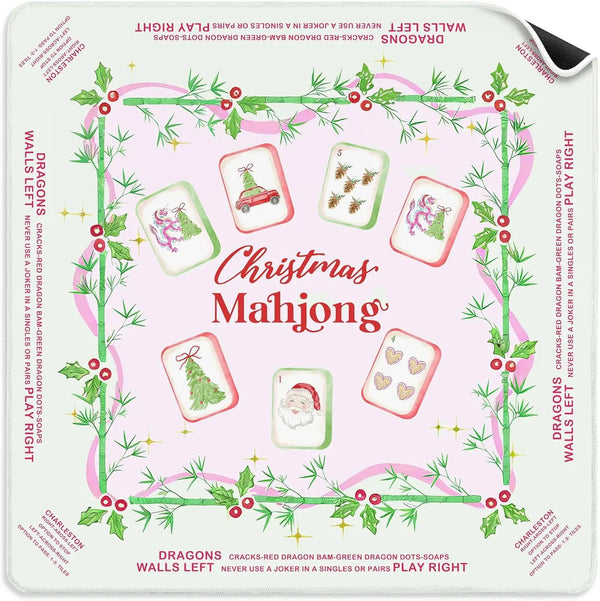
A table mat to quiet the tiles and protect your table, and chips or coins if your group keeps score.
Meet the tiles
152 tiles in seven families. Tap any tile to see its name, how many are in a standard set, and what to watch for.
| Family | What's in it | Tiles |
|---|---|---|
| Bams (bamboo) | 1 to 9, four of each | 36 |
| Craks (characters) | 1 to 9, four of each | 36 |
| Dots (circles) | 1 to 9, four of each | 36 |
| Winds | North, East, West, South, four of each | 16 |
| Dragons | Red, Green, White ("Soap"), four of each | 12 |
| Flowers | All flowers count as the same tile | 8 |
| Jokers | Wild in groups of three or more | 8 |
| Total | 152 | |
The card: your list of winning hands
In American mahjong you can only win with a hand that appears on the card. A new card comes out every year, and most groups play with the current year's card, so check which card your group uses.
The hands are grouped into themed sections. For example, one section may use only even numbers, another runs of consecutive numbers, another winds and dragons. For each hand the card shows:
- The tiles you need, written as groups. Colors show how many different suits the hand uses.
- X or C. X means exposed: you may call discards to build it. C means concealed: you draw every tile yourself, except the final tile that wins.
- A point value used for scoring.
We don't reproduce any hands from the card on this page. Please buy the current card from its publisher, one for each player.
How to play: a game step by step
Eight steps from shuffle to "Mah Jongg!"
- 1
Take your seats
One player is East, the dealer. Going to East's right, the others are South, West and North.
- 2
Build the wall
Shuffle the tiles face down. Each player builds a wall 19 tiles long and 2 tiles high in front of their rack. Together the four walls make a square.
- 3
Break and deal
East rolls the dice to decide where the wall is broken, and tiles are dealt from that point. East ends up with 14 tiles and everyone else with 13.
- 4
The Charleston
Everyone passes three tiles they don't want: right, then across, then left. A second round (left, across, right) happens only if all players agree. It ends with an optional courtesy pass of up to three tiles with the player across. Jokers are never passed. Try it in the trainer ↓
- 5
Play begins
East discards first. Play then moves to the right (counterclockwise). On your turn, draw a tile from the wall and discard one, saying its name out loud.
- 6
Calling a discard
If a discarded tile completes a group of three or more that your hand needs, you can call it. Place that group face up on your rack (an exposure), then discard. You can't call a tile for a single or a pair unless it completes your winning hand. A discarded joker can't be called.
- 7
Joker exchange
On your turn, if a joker sits in anyone's exposure and you hold the real tile it stands for, you can swap your tile for that joker.
- 8
Mah Jongg!
When your tiles exactly match a hand on the card, call "Mah Jongg!" and show your hand. If the wall runs out first, it's a wall game: nobody wins, and you shuffle for the next game.
Scoring follows the point values on the card. House rules vary, but in many groups the player who discarded the winning tile pays double.
Charleston trainer
Practice the passes before your first game. Pick tiles from your hand and pass them the right way. The trainer stops you if you break a rule.
Everything runs in your browser. Nothing is saved or sent.
Beginner quiz
Eight quick questions. Ready for your first game?
Glossary
- Bam, Crak, Dot
- The three numbered suits: bamboo, characters and circles, 1 to 9.
- Soap
- Nickname for the White Dragon. It also stands for zero in hands that spell out a year.
- Matching dragon
- Each dragon goes with one suit: Red with Craks, Green with Bams, Soap with Dots.
- Pung, Kong, Quint, Sextet
- Groups of 3, 4, 5 and 6 identical tiles. A set has only four of each tile, so a quint or sextet needs jokers (or flowers, since there are eight).
- Pair, Single
- Two identical tiles, or one tile on its own. Jokers can never be used in either.
- Exposure
- A group you've placed face up on your rack after calling a discard.
- Exposed (X) / Concealed (C)
- Marks on the card. X hands may use called discards. C hands must be drawn yourself, except the winning tile.
- Charleston
- The tile-passing ritual before play: right, across, left, then an optional second round.
- Blind pass
- On the last pass of each Charleston, you may pass on tiles you've just received without looking at them.
- Courtesy pass
- An optional swap of 0 to 3 tiles with the player across, after the Charleston.
- Joker exchange
- On your turn, trading the real tile from your rack for a joker in someone's exposure.
- Dead hand
- A hand that can no longer match any hand on the card, for example because of a wrong exposure. That player stops playing for the rest of the game.
- Hot tile
- A discard that looks likely to give another player Mah Jongg.
- Wall game
- A game where the wall runs out before anyone wins.
- Mah Jongg
- What you call when your tiles complete a hand on the card. It's also the game's name.
Ready for game night?
Glitter tile sets ship free to the contiguous US. Tilory sets are tiles only: racks, dice and the card are sold separately.

Christmas Glitter Mahjong Tiles — Red
$345.00$269.00 · Tiles only

Christmas Glitter Mahjong Tiles — Green
$345.00$269.00 · Tiles only

Under the Sea Glitter Mahjong Tiles — Ocean Blue
$299.00$249.00 · Tiles only
Helpful while you learn


Questions
Is American mahjong the same as Chinese mahjong?
No. American mahjong uses 152 tiles, including jokers and flowers. Players pass tiles in the Charleston before play, and you can only win with a hand from that year's card.
Do I need the card to play?
Yes. Every winning hand comes from the card, and each player needs their own copy. A new card is published every year.
Do Tilory sets come with racks or the card?
No. Tilory sets are tiles only: 160 acrylic tiles. Racks, pushers, dice, a table mat and the annual card are not included.
Can I practice on my own?
Yes. Use the Charleston trainer above, lay out the hands from your card with your tiles, and take the quiz. Then play a slow first game with friends, with your cards face up.

The Charleston cheat sheet
Right, over, left: every pass of the Charleston on one printable page, plus the setup and joker rules beginners ask about most.
- All six passes, with a table diagram
- Blind pass and courtesy pass, explained
- A pass tracker to tick off at the table
- Setup and joker rules at a glance
Step-by-step guides
View all-

Mahjong Gifts for Every Player and Budget
Mahjong gift ideas for beginners, hosts and serious players, from mugs and mats to glitter tile sets, lessons and last-minute digital gift cards.
Mahjong Gifts for Every Player and Budget
Mahjong gift ideas for beginners, hosts and serious players, from mugs and mats to glitter tile sets, lessons and last-minute digital gift cards.
-

Christmas Mahjong Tiles: How to Choose a Holida...
What to check before you buy a holiday American mahjong set, from jokers and readability to rack fit and delivery, plus our Red and Green editions compared.
Christmas Mahjong Tiles: How to Choose a Holida...
What to check before you buy a holiday American mahjong set, from jokers and readability to rack fit and delivery, plus our Red and Green editions compared.
-

American Mahjong Tiles Explained, With Real Photos
Craks, Bams, Dots, winds, dragons, flowers and jokers: what every American mahjong tile is, how many there are, and how to read themed designer tiles.
American Mahjong Tiles Explained, With Real Photos
Craks, Bams, Dots, winds, dragons, flowers and jokers: what every American mahjong tile is, how many there are, and how to read themed designer tiles.
-

How to Set Up an American Mahjong Game: Wall, R...
Everything that happens before the first tile is discarded: seats, racks, building the wall, rolling the dice and dealing.
How to Set Up an American Mahjong Game: Wall, R...
Everything that happens before the first tile is discarded: seats, racks, building the wall, rolling the dice and dealing.


